The RP Protocol
Field Manual Note
The RP Protocol is a compact self-mastery field manual for prepared calm, mental rehearsal, and precision response.
This edition is authored under the organizational pseudonym and brand identity The PlatinumLogik and published by PlatinumLogik Publishing.
The framework blends practical psychology, performance thinking, tactical rehearsal, and spiritual presence into a usable preparation system.
Core phrase: Rehearse the moment. Prime the mind. Execute with precision.
Inside The RP Protocol
- ManifestoThe Moment Before the Moment
- Chapter OneRP Mode: Prepared Calm
- Chapter TwoRP Training: Mental Reps for Future Impact
- Chapter ThreeRP Protocol: The If/When Command
- Chapter FourRP Charge: The Energy Before Action
- Chapter FiveRP Field: Presence Before Engagement
- Chapter SixR.P.E.: Rehearse, Prime, Execute
- ApplicationThe Five Arenas of RP
- PracticeThe 7-Minute RP Drill
- IntegrationRP Is Not Control. RP Is Command.
- WorksheetsBuild Your RP Protocol
The Moment Before the Moment
When pressure appears, preparation speaks first.
Readiness Potentiality is the disciplined preparation of mind, language, emotion, and intent before a decisive moment arrives. It is the practice of becoming ready before reality demands readiness from you.
The central principle is simple: train the response before the reality. That sentence is the spine of this book. It means you do not wait for pressure, conflict, opportunity, performance, or confrontation to tell you who you are. You decide in advance. You build the inner command. You rehearse the moment. You prime the mind. Then, when life calls the play, you execute with precision.
RP is not anxiety dressed as planning. It is not imaginary arguing. It is not obsessing over every possible outcome. RP is structured internal preparation. It is mental rehearsal with a purpose, emotional discipline with a target, and intentional presence that has been trained before the event appears.
In psychology, this overlaps with cognitive rehearsal, implementation intention, scenario planning, mental imagery, stress inoculation, and response priming. In spiritual language, it touches zanshin, mushin, sankalpa, and prayerful preparation. In performance language, it is the pre-performance routine. In tactical language, it is the battle drill. In PlatinumLogik language, it is the moment before the moment.
RP Drill
Write one future moment that deserves preparation. Name it clearly. Then write the response you want to embody when it arrives.
RP Mode: Prepared Calm
RP Mode is calm with a purpose.
RP Mode is a heightened state of prepared calm. It is the place between passive waiting and tense anticipation. You are not asleep, but you are not clenched. You are awake, centered, and available to act.
Most people treat readiness as adrenaline. They think being ready means getting loud inside, tightening the body, and pushing energy toward the future. RP Mode moves differently. It replaces tension with attention. It teaches the body to stay calm while the mind stays online.
Prepared calm is powerful because it preserves choice. When emotion floods the system, choices narrow. Language gets sloppy. Timing gets rushed. The body starts speaking before the intelligence has organized the message. RP Mode slows the inner scramble so your best response can step forward first.
The RP Mode Command
I do not need to become ready. I enter the moment already prepared.
That command is not decorative. It is a nervous-system instruction. It tells the body that the moment is not an emergency just because it is important. You can be intense without being chaotic. You can be direct without being aggressive. You can be powerful without being loud.
RP Drill
Practice a 30-second reset: inhale for four counts, hold for two, exhale for six. Then say your RP Mode command once, slowly.
RP Training: Mental Reps for Future Impact
Mental reps turn pressure into familiar terrain.
RP Training is the repetition that turns a possible moment into a familiar moment. The mind that has rehearsed the moment does not meet the moment as a stranger.
Think of a musician before a performance, an athlete before a final shot, a speaker before stepping on stage, or a professional walking into a high-stakes meeting. They are not merely hoping to perform well. They have already visited the moment internally. They have heard the opening note, felt the first step, seen the room, and rehearsed the first move.
The power of RP Training is that it reduces the cost of first contact. The first time you practice the moment should not be when the moment is already happening. RP Training lets the future self borrow competence from the present self.
What to Rehearse
Rehearse your opening line. Rehearse your pause. Rehearse the question you will ask if tension rises. Rehearse the tone you will refuse to match. Rehearse the moment when your ego wants to take the wheel and your discipline tells it to ride passenger.
Do not rehearse to control other people. Rehearse to control your access to your own best state.
RP Drill
Choose one upcoming interaction. Rehearse three versions: the easy version, the difficult version, and the surprise version. For each, write your first sentence and your first pause.
RP Protocol: The If/When Command
A protocol is a decision made before pressure arrives.
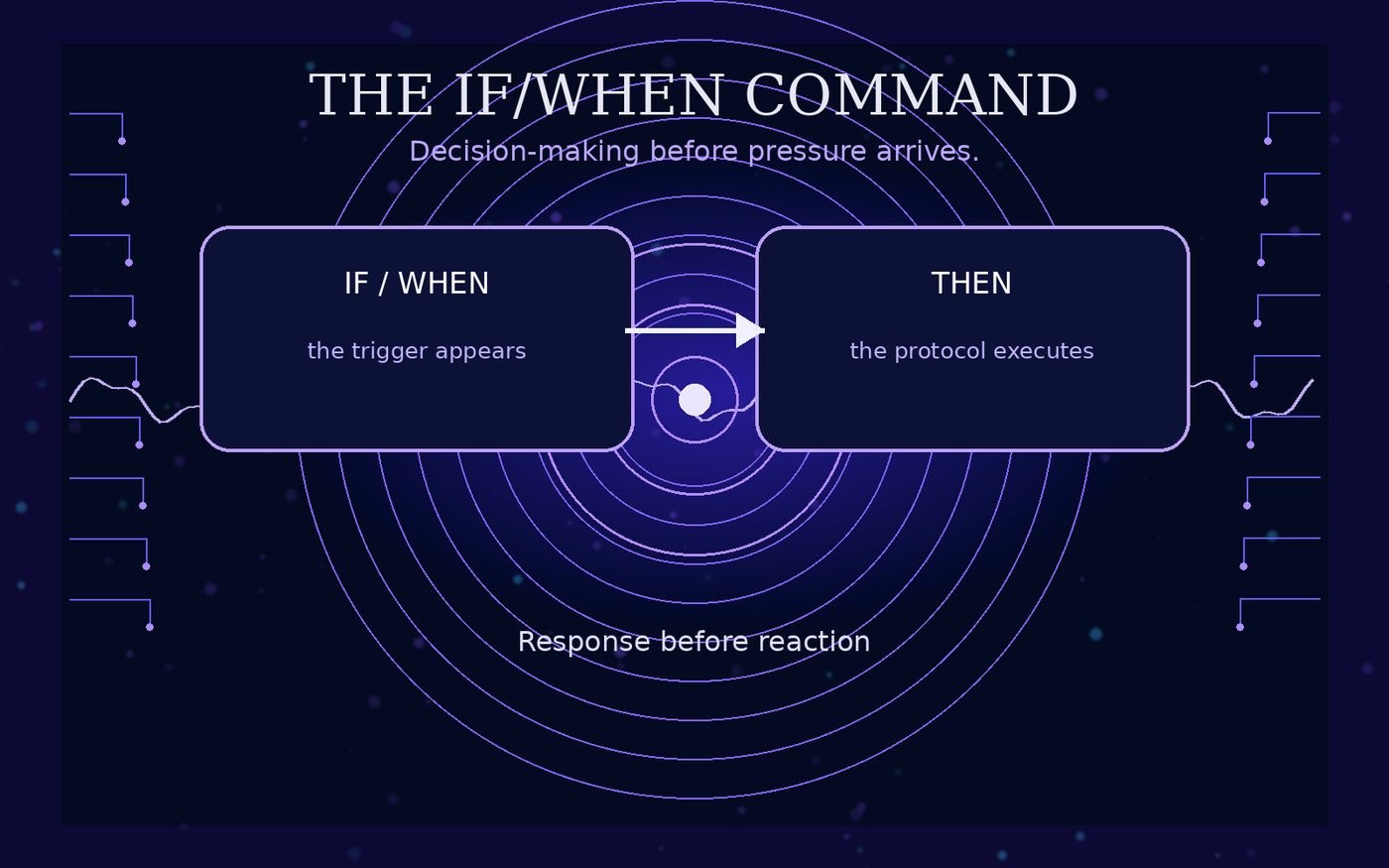
RP Protocol is the operating system of readiness. It converts intention into a usable command: If or when X happens, I will do Y.
This matters because pressure loves ambiguity. If you have not chosen a response before the trigger appears, the trigger may choose the response for you. That is how people get pulled into the wrong tone, the wrong timing, the wrong words, or the wrong battle.
The protocol interrupts the automatic reaction loop. It gives the future self an instruction before the future self is under stress. The stronger the protocol, the less drama is needed to produce action.
Examples
If I am interrupted, then I will pause, breathe, and continue without rushing.
If the conversation becomes hostile, then I will ask one clarifying question before I defend myself.
If an opportunity opens, then I will deliver the prepared line clearly and without shrinking.
If anger rises, then I will let my breath answer before my mouth does.
RP Drill
Build three protocols: one for conflict, one for opportunity, and one for self-control. Keep each in one sentence.
RP Charge: The Energy Before Action
RP Charge is the invisible voltage behind visible action.
RP Charge is the internal energy built before action. It is the voltage of readiness: focus, emotion, intention, and movement gathering behind the visible moment.
Charge is not panic. Panic is scattered voltage. Charge is stored precision. It is the difference between a room full of loose wires and a clean circuit. In RP, energy is not wasted proving that you are intense. Energy is reserved for impact.
The mistake many people make is confusing emotional intensity with readiness. They wind themselves up until they are loud inside, then call it preparation. But readiness is not the size of the emotional wave. It is the quality of the internal alignment.
The Four-Part Charge
Focus: What is the real objective?
Feeling: What emotional state best serves that objective?
Language: What words carry the most truth with the least waste?
Action: What is the next clean move?
RP Drill
Before your next important action, answer the four Charge questions in writing. Keep each answer under ten words.
RP Field: Presence Before Engagement
The field is the atmosphere of readiness surrounding the action.
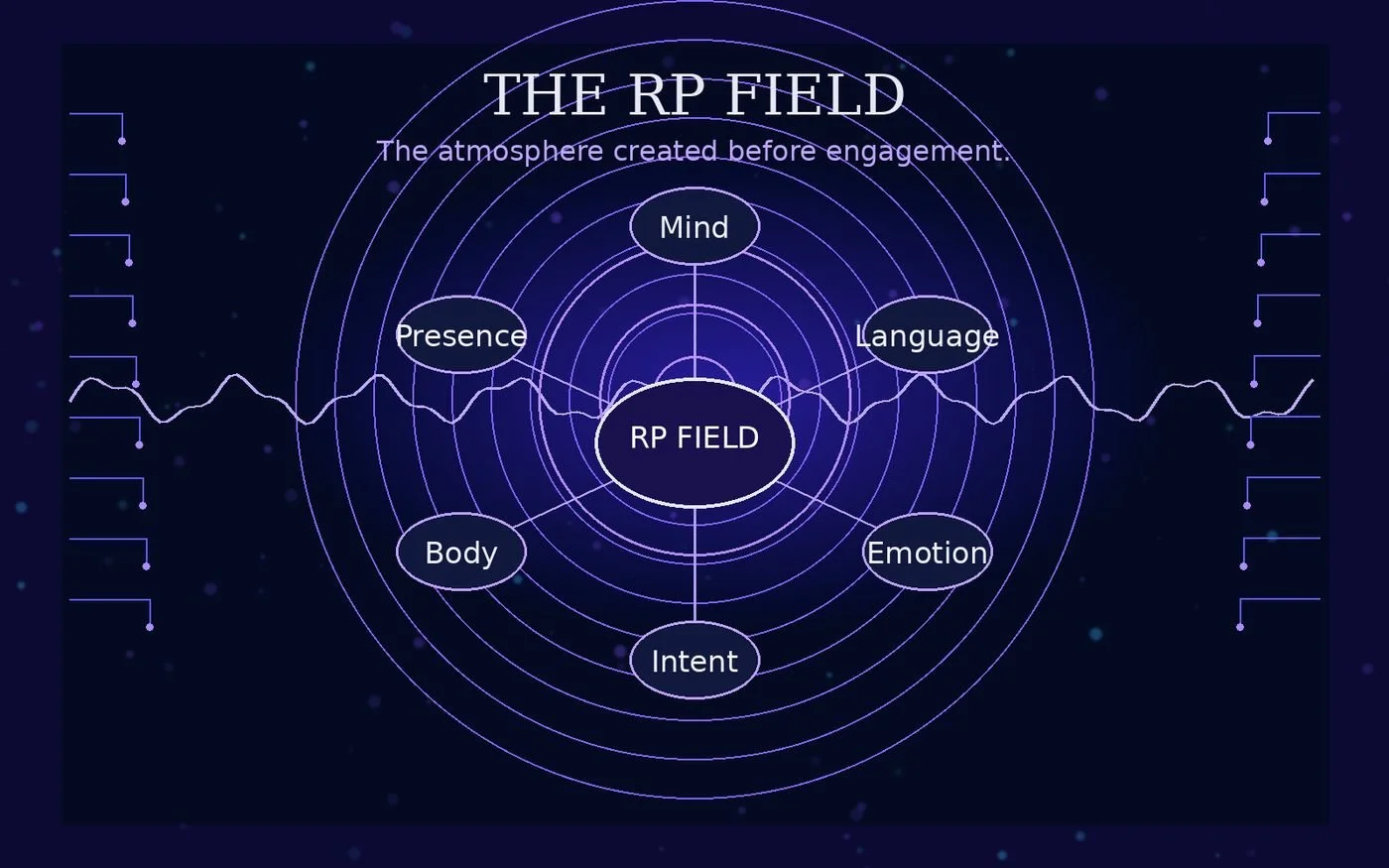
RP Field is the mental and spiritual atmosphere created before engagement. It is the presence that enters the room before your first sentence does.
People read more than words. They read pace, posture, breath, attention, eye contact, timing, and emotional temperature. Your field is the total signal. It is the quiet broadcast of your preparation.
This is where RP becomes more than psychology. It becomes presence. Before you speak, your energy speaks. Before you act, your preparation has already entered with you.
The RP Field is built from mind, language, emotion, intent, body, and presence. When these elements are scattered, the field feels uncertain. When they are aligned, the field feels clean, calm, and difficult to shake.
RP Drill
Stand still for one minute before an interaction. Relax your jaw, lower your shoulders, slow your breath, and choose the energy you want to bring into the room.
R.P.E.: Rehearse, Prime, Execute
Rehearse the moment. Prime the mind. Execute with precision.
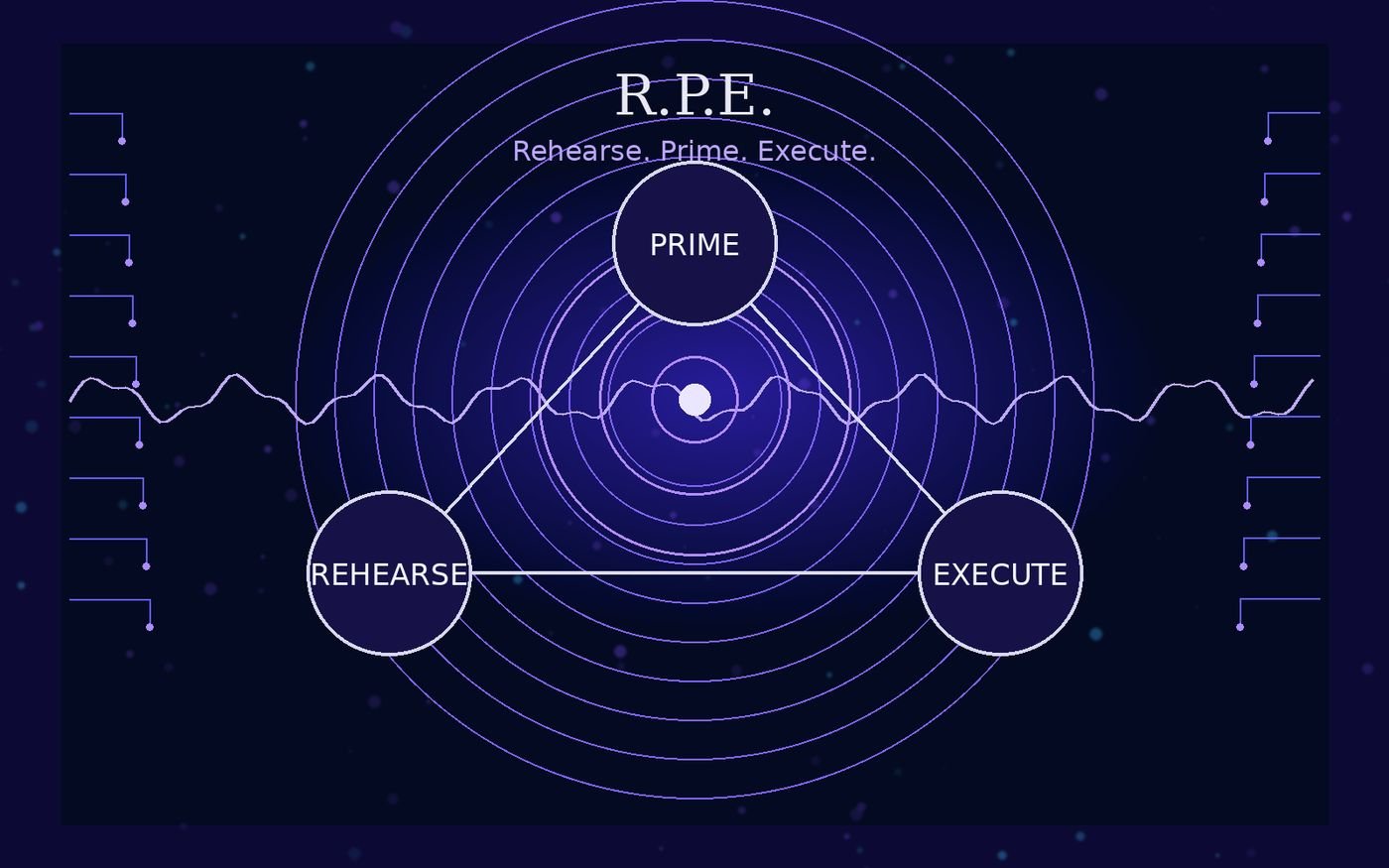
R.P.E. is the core method of The RP Protocol: Rehearse. Prime. Execute.
Rehearse means you mentally walk through the moment before the moment. You imagine the environment, the stakes, the emotional triggers, and the response you want to embody.
Prime means you prepare the mind and body to access the right state quickly. You choose the breath, phrase, posture, and internal command that signal readiness.
Execute means that when the moment arrives, you act from preparation instead of panic. You do not need to perform a new identity under pressure. You simply release what has already been trained.
The magic is not in complexity. The magic is in repetition. The more often you rehearse the sequence, the more natural it becomes. Eventually, RP stops feeling like a technique and starts feeling like your operating posture.
RP Drill
Create a three-line RPE card: one line for what you rehearse, one for how you prime, and one for how you execute.
The Five Arenas of RP
Opportunity also requires readiness.
RP can be used anywhere the quality of your response matters. The framework is especially useful in five arenas.
1. Conversation
Use RP before hard talks, negotiations, apologies, interviews, pitches, and boundary-setting moments.
2. Performance
Use RP before speaking, recording, DJ sets, creative presentations, meetings, auditions, or any public moment where your state affects the outcome.
3. Conflict
Use RP when you know a situation may trigger defensiveness, anger, fear, or old reflexes. Prepare the adult response before the wounded response tries to drive.
4. Opportunity
Use RP before doors open. Opportunity can be just as destabilizing as conflict. You need readiness for the blessing, not only the battle.
5. Self-Mastery
Use RP for the private moments no one sees: the urge, the temptation, the spiral, the procrastination, the impulse to abandon your own standard.
RP Drill
Name one arena where RP would immediately raise your effectiveness. Write the arena at the top of a page and build one protocol beneath it.
The 7-Minute RP Drill
Seven focused minutes can save seven reckless seconds.
This drill is short enough to use daily and deep enough to change your default response over time.
Minute 1 - Name the Moment
Identify the interaction, pressure, decision, or opportunity you are preparing for.
Minute 2 - Name the Trigger
What could knock you out of alignment? Interruption, disrespect, fear, excitement, delay, rejection, or surprise?
Minute 3 - Name the Desired State
Choose the internal state: calm, precise, warm, firm, open, focused, patient, or bold.
Minute 4 - Write the Protocol
Use the formula: If or when X happens, I will do Y.
Minute 5 - Rehearse the First Move
Say the opening line or imagine the first action.
Minute 6 - Prime the Body
Breathe, posture, relax the face, loosen the shoulders, and set the pace.
Minute 7 - Seal the Command
Close with one sentence: I am prepared to respond cleanly.
RP Drill
Use the worksheet section below to run the 7-minute drill for a real upcoming moment.
RP Is Not Control. RP Is Command.
Control is aimed outward. Command is built inward.
There is an important distinction: RP is not about controlling outcomes. It is about commanding your contribution to the outcome.
You cannot guarantee another person will listen. You cannot guarantee the room will be fair. You cannot guarantee the opportunity will land exactly as imagined. But you can increase the chance that your response will reflect your preparation rather than your wound, fear, ego, or impulse.
Control tries to force the world to obey the mind. Command trains the mind to obey the chosen standard.
That is the grown power of RP. It does not promise that every moment will go your way. It promises that you will enter more moments with access to yourself.
RP Drill
Write one thing you cannot control in an upcoming situation. Then write one thing you can command inside yourself.
The Prepared Mind Moves Clean
Stay ready in the unseen, so you can move clean in the seen.
The untrained mind reacts. The prepared mind responds. The disciplined mind executes.
Readiness Potentiality is the art of becoming prepared before preparation is visibly required. It is the invisible rehearsal that becomes visible precision. It is the charge before the strike, the pause before the word, the breath before the choice, the command before the pressure.
When you train the response before the reality, you stop letting every moment introduce you to yourself. You arrive already introduced. You arrive with a stance. You arrive with language. You arrive with breath. You arrive with intent.
That is the moment before the moment. That is The RP Protocol.
RP Drill
Choose one protocol from this book and practice it for seven days. Do not chase perfection. Chase availability to your best response.
Build Your RP Protocol
1. The Moment
What interaction, decision, opportunity, or pressure are you preparing for?
2. The Trigger
What might disrupt your calm or pull you into reaction?
3. The Desired State
What state do you choose before the moment arrives?
4. The Command
If/when this happens, I will execute this response:
5. The First Line
What is the first sentence, pause, or action?
6. The Seal
Write the sentence that locks in your readiness.
RP Reflection Log
| Moment | Protocol Used | What Worked | Next Adjustment |
|---|---|---|---|
The Response Before the Response
RP is the invisible rehearsal that becomes visible execution.